The Astrology Center of America, 207 Victory Lane, Bel Air, MD 21014
Tel: 410-638-7761; Fax:410-638-5154; Toll-free (orders only): 800-475-2272
Home Author Index Title Index Subject Index Vedic Books Tarot E-Mail: Dave


Ephemerides


An Ephemeris (plural, ephemerides) is a daily table showing planetary positions. The first printed ephemerides date from about 1600 and were a controversial innovation. Many astrologers felt those who couldn't calculate planetary positions probably couldn't calculate - or read - a chart, either. Early hand calculated ephemerides were often inaccurate as well. Oddly enough, it wasn't the astrologers who were most interested in keeping track of planetary positions. It was the navy - the British navy, especially. Nowadays, it's the Jet Propulsion Lab in Pasadena. All modern ephemerides (and tables of houses, too) are computer generated and extremely accurate.

Sample pages are now individual pdf files. They were scanned at 100% size, 600 dpi. With a cable modem they load rather fast. PDF files can be enlarged, to see all the details.

For Sidereal, Heliocentric, Midpoint ephemerides, see Specialized Ephemerides

For Asteroid ephemerides, see Asteroids

For Tables of Houses, see Tables of Houses, Calculation Aids, etc.

Indicates a book on our Top Ten list. If you would like to find more books like it, click on the star.

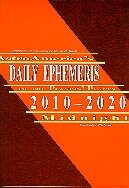
ASTROAMERICA'S DAILY EPHEMERIS, in three volumes, MIDNIGHT. Compiled by David R. Roell
For the years: -------2000 - 2020------------2000 - 2010------------2010 - 2020


2000-2020 (21 years)

Midnight GMT
260 pages
$29.95

2000-2010 (11 years)

Midnight GMT
140 pages
$19.95

2010-2020 (11 years)

Midnight GMT
140 pages
$19.95


Contents: For each of the three books:

Daily:
Longitudes and declination, Midnight, GMT, for Sun, Moon, Mercury, Venus, Mars, Jupiter, Saturn, Uranus, Neptune, Pluto & the True Node.
Daily Sidereal Time.
Complete aspectarian, including declinations.
Last aspect (void-of-course) and lunar ingress.
Lunations and eclipses.

Every Three Days: Chiron's longitude (its declination given monthly). Chiron's stations & ingresses precisely timed.

Monthly: Ayanamsa, Julian day, mean node and SVP (Synthetic Vernal Point).

In the Introductory, the key to computing a daily mean node, an explanation of the Julian day, and the Ayanamsa defined, with instructions how to use it. Additionally, how to compute Nakshatras, with a handy list of all 27 (28).

Comment: From the back cover:

"I once had a nice 20th century ephemeris, with good, clean, easy to read layouts, eclipses at the very top of the page where I could find them, lunar phases and void-of-course that I could actually make sense of, with a nice, clear aspectarian at the bottom. It was a French thing (later a Kansas thing - I'm a Kansas boy, I liked that), but on December 31, 2000, it ended. The "replacements" just weren't as good. I've been stranded ever since.

So after years of frustration, I decided to make my own ephemeris. Halfway through the Aspectarian overwhelmed the page size. With bigger pages and a bit of extra room, I added Chiron, and I'm glad I did. For the first time in a standard ephemeris, Chiron every three days, its stations and ingresses precisely timed, as well as its declination ('Dec') given monthly. I hope this will encourage further study of this notable celestial body.

The ephemeris project took longer and was more work than I expected, but I am pleased with the results. I hope you find it as useful as I do."

This is the best 21st century ephemeris available in America. In addition to clear, easy to use layouts, it's also a convenient size: 7 x 10 inches, or 17.5 x 25.5 cm. Click here for a sample page (PDF).

David R. Roell started his study of astrology in 1983. Since 1993, he has run The Astrology Center of America.

Astrology Classics

Customer Review: Congratulations on creating a great ephemeris! I have been struggling with two different ones, neither of which, even together, have all I need. - Karen Christino, author of What Evangeline Adams Knew.
---- The compiler


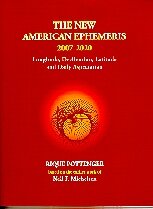
THE NEW AMERICAN EPHEMERIS 2007-2020 (midnight) - Rique Pottenger, $19.95

Contents:

Introducing the New American Ephemeris 2007-2020
About Rique Pottenger
Key to the ephemeris

Ephemeris pages

There is a lot in this book. Let's unpack it carefully:

Daily listings of:
Longitudes for: Sun, Mean Node, True Node, Mercury, Venus, Mars, Ceres, Jupiter, Saturn, Chiron, Uranus, Neptune & Pluto

Declinations & Latitudes for: Sun, Mercury, Venus, Mars, Ceres, Jupiter & Saturn.

Every 12 hours:
The Moon's longitude, latitude & declination

Every 5 days:
Longitudes of Pallas, Juno, Vesta
Declination & Latitude of Chiron, Uranus, Neptune, Pluto, Pallas, Juno, Vesta, Eris

Monthly:
Julian Day. Obliquity. SVP on Aldebaran. Galactic Center. Longitude for Eris.
Moon's phases. Date/time of Moon's maximum & minimum declination (N/S) & equatorial crossings.
Moon's void of course & sign ingress

Daily Aspectarian, which includes Chiron & Ceres. Times are 24h clock, not am/pm, as in earlier ACS editions.

Comment:
A lot in one book. The inclusion of Eris will surprise many (surprised me). Retrograde periods are shaded, though this is not clear on my pdf scan. As is traditional with previous ACS decade books, eclipses are marked, but not well-marked and are easily overlooked. There are also no indications of eclipse intensity, nor are they distinguished between full & partial. Aside from the large size, eclipses are the only serious flaw in the book, which is otherwise excellent & advances the study of the Art.

Click here for a sample page.

Starcrafts Publishing, 174 pages, oversize.


THE ROSICRUCIAN EPHEMERIS 1950-2000 - Rosicrucian Fellowship, $23.00

What would you pay for a really good ephemeris with clear, easy-to-read layouts? Features:

  • One month per page
  • DAILY declinations
  • DAILY aspectarian (including moon)
  • Solar/lunar eclipses (the best format I've yet seen)
  • Lunar ingress & last aspect
  • True node
Also includes:
  • Sun & moon to the nearest second of arc
  • Planetary ingresses
  • Full aspectarian, including lunar aspects & declination aspects
  • Stationary/retrograde times
  • Mean node given monthly (true given daily)
  • Times & longitudes of lunar phases
  • Lunar ingresses & last aspect (eg, void-of-course)
  • Julian day, SVP on Aldebaran, Ayanamsa on Spica, ecliptic obliquity & nutation.
  • Includes instructions in English, French, German, Spanish & Italian.

Our favorite 20th century ephemeris. Click here to see a sample page (pdf)

February 2, 2007: Special Note: The Rosicrucian 1900-2000 ephemeris is out of print. The Rosicrucians inform me that when supply of this 50 year book is exhausted, it will also go out of print. Apologies.

Rosicrucian Fellowship, 694 pages.


Rique Pottenger


Neil Michelsen
(1931-1990)

THE NEW AMERICAN EPHEMERIS FOR THE 21ST CENTURY, 2000-2100 at Midnight - Rique Pottenger, based on the work of Neil Michelsen, $26.95

Contents:

Dedication; Birthchart of Neil F. Michelsen; Remembering Neil; Friends & colleagues remember...; Introduction to the New American Ephemeris; Key to the phenomena section; The ephemeris

Daily positions of:
Sidereal time; Sun, True node, Mercury, Venus, Mars, Ceres, Jupiter, Saturn, Uranus, Neptune, Pluto

Twice daily:
The Moon's longitude

Monthly:
Julian day, SVP on Aldebaran, Galactic Center, Eris, Chiron, Mean node, Pallas, Juno, Athena

Also included:
Stations. Planets (including Moon) crossing 0 degrees declination. Planetary ingresses. Jupiter through Pluto aspects (of which there are few). Lunations. Last aspect / Ingresses (aka void of course). Eclipses.

Notably missing:
Ayanamsa

Comment: This is the Michelsen Memorial Edition, published in honor of the 30th anniversary of his pioneering American Ephemeris 1931-1980 (which is out of print). As if to show that all good things come in twos, this new ephemeris was published within a month of my new ephemerides, which you can see at the top of this page.

The printing & layout are slight improvements over the aging The American Ephemeris series. Eclipses are still shown by the tiniest of symbols & so remain difficult to find. Inspired by 2006's International Astronomer's Union resolution that Ceres & "Eris" (a largish body found beyond the orbit of Pluto) have special significance, they are included here, Eris for the first time anywhere. Click here for a sample page (PDF).

As I've mentioned elsewhere, I do not think ephemerides that project so far into the future are good buys, but I am happy to offer this for those of you who need these advance dates.

Starcrafts Publishing, 622 pages.


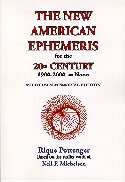
NEW AMERICAN EPHEMERIS FOR THE 20TH CENTURY at Midnight, 1900-2000 - Rique Pottenger, $29.95

Contents:

Dedication
Introduction to the New American Ephemeris
Key to the phenomena section

The ephemeris

Daily positions of:
Sidereal time; Sun, True node, Mercury, Venus, Mars, Ceres, Jupiter, Saturn, Uranus, Neptune, Pluto

Twice daily:
The Moon's longitude

Monthly:
Julian day, SVP on Aldebaran, Galactic Center, Eris, Chiron, Mean node, Pallas, Juno, Athena

Also included:
Stations. Planets (including Moon) crossing 0 degrees declination. Planetary ingresses. Jupiter through Pluto aspects (of which there are few). Lunations. Last aspect / Ingresses (aka void of course). Eclipses.

Notably missing:
Ayanamsa

Comment: Identical in format to their new 21st century book (above). Unlike that book, this was printed by Lightning Source. My calculations are the publishers are not actually making a profit on this book, which makes it a labor of love. For which, my thanks. It's good to have this back in print.

Note to Maria Kay Simms, the publisher: The settings used to produce the PDF file you sent to Lightning Source were not quite right. This is why the left-hand (even) pages are darker than the right-hand (odd) pages. Call your rep, see if he can help. If by chance you used PageMaker 6 or 7, the correct settings are here.

Note to Lightning Source: Please re-post your earlier instructions. Ms. Simms is the second publisher I've found with this embarrassing problem.

Note to the rest of the world: If it's not pointed out, you will not notice this slight flaw. Which is why Ms Simms did not.

See a sample page here. (This is from the darker side.)

Starcrafts Publishing, 617 pages.


AMERICAN EPHEMERIS FOR THE 21st CENTURY, 2001-2050 MIDNIGHT, expanded 2nd edition - Neil F. Michelsen, revisions by Rique Pottenger, $18.95

Daily positions, at MIDNIGHT for:

  • Sun, moon & planets
  • Moon's true node
Also:
  • Direct/retrograde times
  • aspectarian of outer planets
  • Moon phases, eclipses, void of course
  • Planetary ingress, planetary crossing of celestial equator
Monthly:
  • Chiron's position, the galactic center, synthetic vernal point, mean lunar node, Julian day number.

Click here to see a sample page (pdf).

ACS, about 312 pages.


AMERICAN EPHEMERIS FOR THE 21st CENTURY, 2000-2050 NOON, expanded 2nd edition - Neil F. Michelsen, revisions by Rique Pottenger, $18.95

Daily positions, at NOON for:

  • Sun, moon & planets
  • Moon's true node
Also:
  • Direct/retrograde times
  • aspectarian of outer planets
  • Moon phases, eclipses, void of course
  • Planetary ingress, planetary crossing of celestial equator
Monthly:
  • Chiron's position, the galactic center, synthetic vernal point, mean lunar node, Julian day number.

Identical to the 2000-2050 Midnight edition (above), except for NOON, GMT.

Click here to see a sample page (pdf).

ACS, about 312 pages.


AMERICAN EPHEMERIS FOR THE 20th CENTURY, 1900-2000 NOON - Neil F. Michelsen, revisions by Rique Pottenger, $26.95
Daily positions, at NOON for:
  • Sun, moon & planets
  • Moon's true node
Also:
  • Direct/retrograde times
  • aspectarian of outer planets
  • Moon phases, eclipses, void of course
  • Planetary ingress, planetary crossing of celestial equator
Monthly:
  • Chiron's position, the galactic center, synthetic vernal point, mean lunar node, Julian day number.

Identical to the 21st century midnight version (above) except for NOON. Click here to see a sample page (pdf).

ACS, about 608 pages.


DIE DEUTSCHE EPHEMERIDE BAND VIII, 2001-2020, $42.00

One month per two page spread. Features:

  • Zodical positions given daily
  • Sun to the nearest second
  • Declination of the Sun given daily
  • Declination & latitude of Moon daily
  • Declinations for the other planets given every three days
  • Mean lunar node.

In the back:

  • Pluto ephemeris, 1850-1960 (for earlier Bands that lacked it)
  • Latitude & longitudes for major world cities
  • An overview of time changes in Europe since 1582 (includes some of the most detailed notes on the change from Julian to Gregorian calendars that I have seen)
  • Table of logarithms.

Non-standard planetary order. No lunations, no eclipses, no aspectarian, just your plain nuts & bolts ephemeris. Click here to see a sample page (pdf)

Otto Wilhelm Barth Verlag, 557 pages, hardcover with dust jacket. Size (closed): 3.8 x 7 inches, or 95 x 178 mm.


Choice of Midnight (above),
or Noon (below) editions.

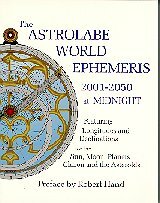
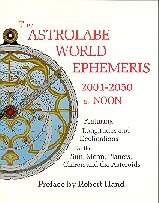
THE ASTROLABE WORLD EPHEMERIS, 2001-2050 - Astrolabe, with an introduction by Robert Hand, $29.95

Choice of Noon or Midnight editions. Both feature:

  • Daily positions & daily declinations for sun, moon & planets
  • Moon's zodiacal position given twice daily
  • Daily positions & declinations for Ceres, Pallas, Juno, Vesta & Chiron
  • Lunar data includes last aspect & ingress (eg, void of course), as well as the time of lunar phases (new, 1st, full 3rd), but not the zodiacal position
  • Eclipses are given, but not their zodiacal positions & the format used makes finding them difficult.
  • Sun's entry into signs are given.
Missing features:
  • No aspectarian, no Julian Days, no SVP on Aldebaran or ayanamsa.
The mean node position is used throughout. See a full size page from this book at Astrolabe World Ephemeris, 2001-2050 (pdf).

Whitford, paper.


SIMPLIFIED SCIENTIFIC EPHEMERIS, 2010-2019

For Noon, GMT, computer calculated, by The Rosicrucian Fellowship: $19.95

Similar to the 50 year Rosicrucian Ephemeris, 1950-2000, shown above, but with slightly larger print. Feature:

  • Set for Noon, GMT
  • One month per double-page spread
  • Unique planetary order: Sun, Venus, Mercury, Moon, Saturn, Jupiter, Mars, Uranus, Neptune, Pluto, True node
  • Eclipses shown at the top, the best place for them.
  • Following the December ephemeris is a complete aspectarian for the year, in six pages
  • For each year, a Table of Proportional Logarithms.
As for each year there is a distinct title page, followed by an identical page on Time Changes. If the comb-binding was removed, the result would be ten individual year ephemerides, identical in every respect to the Rosicrucian annual ephemerides (well, except for the holes!). See a Sample page.

Or get the annual Rosicrucian ephemeris, identical in every respect, here.

Other notes: While I find the planetary order annoying, the Aspectarian section, which follows the monthly listings, is first-rate. It includes Ptolemaic aspects, solar/planetary sign ingresses, stations and parallels & counter-parrels of declinations. The Rosicrucian counter-parallel symbol (|| with a - through it) is generally weak, but can usually be figured out. The Aspectarians lack lunar sign ingresses & do not indicate eclipses, but both of these are prominently featured in the monthly section.

Rosicrucian Fellowship, comb bound, about 360 pages.


POCKET SIZED ASTROEPHEMERIS, 1900-2050 - H.M. "Gen" Ishikawa, $14.95
Contents: Astrology in science & art (an essay); Changes in planets; Ishikawa's number in Sun-Mars aspects; Decision tree of the concept of human; Table of Placidus house cusps, 10, 20, 30, 35, 40, 45, 50, 55; Table of mean sidereal times in the normal years; Table in the leap years; Quick reference table of ASC, Jan-Apr, May-Aug, Sep-Dec; Quick reference table of Placidus houses 35 N; Condensed ephemeris of 151 years.

Comment: A tiny book (measures 3.6 x 6.5 inches, or 93 x 165 mm), with tiny, tiny printing. Slightly larger than a pair of eyeglasses, will fit in a man's shirt pocket. See here for a sample page (pdf) and more details as to display.

The introductory essay is the author's philosophical orientation (astrology is primitive, accuracy better than a degree in planetary positions is not necessary, one's elevation above sea level should be taken into account in computing the ascendant, etc.). The condensed house positions are given every ten minutes. The Decision Tree is cosmology diagram, the emphasis on 35 degrees north is because Tokyo is located at that distance from the equator, etc. The author has for many years been a member of the board of the American Federation of Astrologers.

In this ephemeris, the Sun is given once every ten days; Moon every other day; Mercury every three days; Venus & Mars every five days; Jupiter, Saturn, Ceres, Pallas, Juno, Vesta every 10 days; Uranus & Neptune twice a month; Pluto, the node & Chiron once a month. There is no aspectarian, no void of course, no ingress, no eclipses, no Julian Day, no SVP, no ayanamsha, etc.

AFA, 182 pages.


200 YEAR EPHEMERIS, 1800-2000 inclusive (no moon) - Hugh MacCraig, $19.00
In the ephemeris section:
  • Monthly positions for NOON GMT are given monthly: Sun, Mercury, Venus, Mars, Jupiter, Saturn, Uranus, Neptune & Pluto (yes, Pluto, back to 1800)
  • Day/month/year of planetary stations, also the exact degree/minute position for each station.
  • Solar/lunar eclipses.
  • Monthly declinations, monthly latitudes.
Also:
  • List of symbols used in the book
  • Table of mean motion for all planets
  • Table of approximate period in which planet is retrograde & stationary
  • Table of planetary nodes
  • Master table of sidereal time
  • How to erect a chart using this ephemeris
  • Table of approximate correction between mean & sidereal time
  • World time meridians
  • 7000 Latitudes & longitudes of the world (with longitudes in time)
  • Some general notes on the calendar (including the Hebrew & Mohammedian calendars)(worth the price of the book all by itself)
  • Day of the week calendar
  • Monthly heliocentric positions (Mercury, Venus, Mars, Jupiter, Saturn, Uranus, Neptune, Pluto) from 1800-2000
  • Addenda: A brief essay on heliocentric astrology.
A fabulous book, more useful than you might imagine. Click here for a sample page (pdf).

420 pages. Macoy Publishing, flexible hardcover.


EPHEMERIS OF THE MOON, 1800-2000 inclusive - Hugh MacCraig, $10.00
The exact dates & times of the moon's entry into signs, from 1800-2000, inclusive.

Also features:

  • Exact times & positions of lunations (new & full moons)
  • Introduction & explanation of how to use the Ephemeris of the Moon
  • Zodiacal longitude of the moon for any day, at any time, of any year between 1800-2000, as obtained from Tables 1 & 2 (to be used in conjunction with the main ephemeris listings)
  • Table of Easter dates
  • Addenda 1: Solar Ingresses from 1800-2000 (all four per year)
  • Addenda 2: Major conjunctions from 1800-2000 (including Mars/Jupiter, Mars/Saturn, Mars/Uranus, Mars/Neptune, Mars/Pluto; Jupiter/Saturn, Jupiter/Uranus, Jupiter/Neptune, Jupiter/Pluto; Saturn/Uranus, Saturn/Neptune, Saturn/Pluto; Uranus/Neptune, Uranus/Pluto; Neptune/Pluto).
Another great reference book.

247 pages. Macoy Publishing, hardcover.


For Sidereal, Heliocentric, Midpoint ephemerides, see Specialized Ephemerides

For Asteroid ephemerides, see Asteroids

For Tables of Houses, see Tables of Houses, Calculation Aids, etc.


The Astrology Center of America

207 Victory Lane, Bel Air, MD 21014
Tel: 410-638-7761; Fax:410-638-5154; Toll-free (orders only): 800-475-2272

Home Author Index Title Index Subject Index Vedic Books Tarot E-Mail: Dave


Established 1993, The Astrology Center of America is owned & operated by David Roell.
This entire site (AstroAmerica.com) is copyright 1996, 1997, 1998, 1999, 2000 by William R. Roell.
All rights reserved.