The Astrology Center of America, 207 Victory Lane, Bel Air, MD 21014
Tel: 410-638-7761; Fax:410-638-5154; Toll-free (orders only): 800-475-2272
Home Author Index Title Index Subject Index Vedic Books Tarot E-Mail: Dave


Astrological Essays, page 3


Astrological Essays: Page 1 Page 2 Page 3

Here are more essays on astrological themes.

Indicates a book on our Top Ten list. If you would like to find more books like it, click on the star.
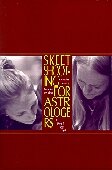
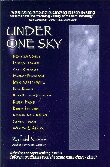
UNDER ONE SKY: Astrologers representing twelve different traditions read the same natal chart - blind! - Rafael Nasser, edited by Jodie Forrest, $24.95
Contents:
Editor's note; Preface; Prologue; Part 1: The astrologer's forum; Part 2: Joyce's story; Part 3: The interpretations:
  • Thumbnail sketches
  • Demetra George: Asteroid centered
  • Evelyn Roberts: Archetypal
  • Gary Christen: Uranian
  • Hadley Fitzgerald: Psychological
  • John Marchesella: Modern western
  • Ken Bowser: Western sidereal
  • Kim Roger-Gallagher: Light-hearted
  • Robert Hand: Medieval
  • Robert Schmidt: Hellenistic
  • Ronnie Gayle Dreyer: Vedic
  • Steven Forrest: Evolutionary
  • Wendy Z. Ashley: Mythological
Epilogue; Glossary

Comment: This was Nasser's idea, which makes him the producer of the book. He wondered how twelve different astrologers would "read", blind, the same chart. His method was to solicit twelve written interpretations of the same chart, that for "Joyce", born January 16, 1943, 4:18 pm CWT, Pryor, OK. The book suffers from two conceptual flaws: Astrologers were not chosen for their ability at blind readings, nor were they chosen for their ability at written interpretations. All have, or believe they have, strong writing skills. (At least eight have written books.) The result reads like twelve advertisments ("buy me!" "buy me!"), but, for the most part, cannot be indicative of actual reading styles, which are usually oral. For that matter, "Joyce" herself has strong writing skills: Her autobiography runs 41 pages & reads like a novel.

It is said that, based on "Joyce's" own story (which, of course, none of the astrologers read until after their interpretations were finalized), some astrologers got things more right than others. As "Joyce's" self-described history is subjective & as none of the astrologers provide their own birth-data, terms such as "right" or "wrong", "correct" or "incorrect", with regards to the readings, are meaningless. With these caveats, this is an interesting book.

Seven Paws Press, 489 pages.


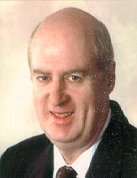
Nicholas Campion
SKY & PSYCHE: The relationship between cosmos & consciousness - edited by Nicholas Campion & Patrick Curry, $35.00

Contents:

Acknowledgments
Introduction: Sky & Psyche, heaven & soul, by Nicholas Campion

Part 1: The Alchemical Sky:
1. Love & the alchemical Saturn, by Liz Greene
2. The azure vault: The caelum as experience, by James Hillman

Part 2: Sky & Psyche:
3. Chartres Cathedral & the role of the Sun in the cathedral's Christian Platonist theology, by Bernadette Brady
4. Life across the cosmos, by Neville Brown
5. Imagining eternity: Weaving "The Heavens' embroidered cloth", by Jules Cashford
6. The soul of the sky, by Noel Cobb
7. The Russian spirit of place, by Cherry Gilchrist
8. A dimensional model for the relationship of consciousness & cosmos: Mathematical abstraction vs: conscious experience, by Robert Hand
9. Sun gods & moon deities in Africa, by Jarita C. Holbrook
10. Where the heavens meet the earth: Inspirations from the lives of Carl Jung, Jalal-u-din Rumi & Mahatma Gandhi, by Nicholas Pearson
11. Understanding the modern disenchantment of the cosmos, by Richard Tarnas
12. The secret life of statues, by Angela Voss

The Sophia Center
Contributors

Comment: Nicholas Campion's Introduction will set the stage. He is the director of the Sophia Centre at Bath Spa University.

The chapters in this book are based on lectures delivered at two conferences held in Bath on May 1 [Sunday] & July 1-2 [Friday-Saturday], 2005, respectively: "The Alchemical Sky" and "Sky & Psyche". Both events were initiated by Bath Spa University's Sophia Centre, and were designed, as the title of the second event suggests, to address the question of the relationship of between sky & psyche - in their broadest sense. Psyche, in particular, has a double meaning as soul and mind. Until the seventeenth century the two were indistinguishable; soul was that part of mind which could communicate with, travel to, and/or unite with, God. Alchemical sky, meanwhile, points to the possibility of transmutation - or tramsformation; that the psyche's ability to reflect on the heavens necessarily involves what we might nowadays call an evolutionary process.

The question of the relationship between the soul & the stars has been central to cosmology for thousands of years. The belief in the soul's journey to the stars permeated Egyptian thought. It appeared amongst the Greek Orphics, perhaps under Egyptian influence, from where it made its way into Plato's teachings in fourth century BCE Athens. Thanks to Plato's impact on the Church Fathers, his theories became a persistent, if controversial, part of Christian theology. In fact, one could argue that the entire Christian notion of soul is pagan. The belief that the soul could embark on a celestial journey draws attention to the cosmos as a real, physical space, one in which morality varies with the region within which one finds one's self. For medieval Christians, Heaven, the soul's natural home, was located above earth - beyond the stars.

To paraphrase Rob Hand, who spoke at the "Sky & Psyche" conference, the relationship of soul to stars was the central problem in cosmology during the centuries when Christian theology was being formulated and was fighting for supremacy over its pagan & heretical rivals. Did the soul come from the stars? If so, how did it return? Could it return? Did it even want to? These were the sort of questions that pervaded discussions of humanity's relationship with the divine.

While much modern psychology has become almost entirely dissociated from psyche in its original sense, the reaction to such ideas began with Jung in the 1910s and has found a home in the various schools of post-Jungian and transpersonal psychology. Plato's idea of the rational mind, that part of the psyche which was in contact with the divine, survives in various forms. His Idealism, which presented mind as independent of matter, flourishes, unrecognized, in a world in which most academic disciplines take materialism as their starting point. Plato's cosmic order though, survives in one other significant area apart from depth psychology, and that is pure mathematics. John Barrow, professor of mathematical sciences at Cambridge University and one of the orginators of of the anthropic principle, in which the universe & human life are to one degree or another mutually dependent, discussed "mathematical Platonism", which he considered "almost religious in the sense that it provides an underpinning necessary to give meaning to life & human activity." Roger Penrose is another mathematical Platonist. Professor of Mathematics at Oxford University, he shared the 1988 Wolf Prize for physics with Stephen Hawking. Penrose's explanation for the manner in which mathematics allows for intellectual inquiry is instructive.... (pg. 9-10)

This should be enough to give an idea of the book. It would seem the seminar topic became an excuse for papers on the contributors' pet projects, provided they could work "Platonism" into it. For example, Bernadette Brady's article, on Chartres Cathedral, relates her discovery that at sunrise on Christmas Day, the sun shines directly into the south transept, while, only a few hours later, the Xmas setting sun shines directly through the great western portal, straight up the nave itself. A fabulous feat of architecture, but nothing whatever to do with where your soul goes after you're dead.

Dear Sophia People: Compilations that are on topic will get a better reception than grab-bags. Topics that are relevant, which can be expressed in common terms, will beat out abstractions. Finally, Carl Jung is not God. He's not the Word of God, he's not even a good God substitute. Metaphysically, his ideas are crude. Endless, mindless repetition has not improved them. Given the harm his many crusaders are causing, a moratorium is overdue.

Floris Books, 234 pages.


ASTROLOGY FOR TODAY - Joanna Watters, $22.00
Contents: Introduction
1. Sun signs
2. The planets
3. The horoscope
4. Significance & symbolism
5. Transits & prediction
6. Locating progressions
7. Relationships
8. Astrology in action

Ephemerides; Glossary; Index; Acknowledgments

Comment: This is a very nice book about what astrology is & what it's like to be an astrologer, in practical terms. But on the way to getting itself printed, the text ran into a fancy high street publisher who smothered it with pictures & fancy layouts & turned it into a coffee table book.

Which made it hard to find the author's original text underneath it all. But look hard. It's there. And it's worth a read.

For example, the chapter on Relationships, which form the bulk of Watters' astrological business. First, she offers guidelines: Look at the 7th house, 1st house, planets in the 7th, Venus, Mars, the lights. Then follows brief pointers on synastry, with Catherine Zeta-Jones & Michael Douglas as a romantic couple, a brief comparison of a Cancer/Aries sun sign couple, the "cosmic marriage", which Watters defines as one Sun conjunct the other's Moon, other powerful forms of synastry, a note on Saturn, Saturn & serious love, Saturn in synastry. Then Uranus & John & Yoko, romantic or redeeming love, Neptune in synastry, Pluto & obsessive or healing love. The chapter ends with case studies, which are perhaps the best thing in the book. The author writes directly about her own experiences as a counselor, about the stuff she got right, about the many other times she didn't figure it out until it was all over. There's nothing here that's comprehensive, there's nothing in real depth, but the writing has immediacy.

Carroll & Brown, 160 pages.


ASTROLOGY'S COMPLETE BOOK OF SELF-DEFENCE - Robert Parry, $16.95
Contents:
Introduction.

Part 1: What is Astrology? 1. The experience of astrology; 2. Tools of the trade; 3. From magic to mockery; 4. Going to an astrologer.

Part 2: Self-Defence: 5. Know the enemy; 6. Dealing with the bully; 7. Basic blocks; 8. Introducing the form; 9. Combat.

Part 3: Where is Astrology Going? 10. The arm of the law, the hounds of the press; 11. Cautionary tales; 12. Lies, damned lies & statistics; 13. Final pep talk.

Notes & references, Glossary of terms, Useful addresses, Suggested reading list, Index.

Comment: Ever wonder what to say to people who claim that astrology is bunk? Get this book & find out. Written to the fairly crude level where anti-astrology attacks usually take place, with many useful details. This book defends astrology the way astrologers traditionally want it to be defended.

Quantum/Foulsham, 224 pages.


ASTROLOGY FOR THE 21ST CENTURY - David Cochrane, $17.95
Contents: 1. Historical Perspective: Valid disciplines surpass our expectations; 2. The search for a starting point in astrology; 3. Theories on how & why astrology works; 4. Short digression: How I became interested in astrology; 5. Energy process interpretation of the planets; 6. Energy process interpretation of the Zodiac signs; 7. Energy process interpretation of the houses; 8. Harmonics!; 9. Degree meanings; 10. Compatibility analysis; 11. Treasure maps; 12. September 11, 2001; 13. A research study; 14. A second research study; Bibliography.

Comment: David Cochrane is the guy behind Cosmic Patterns astrology software (the famous Kepler program, among others).

This book is the culmination of 30 years of wrestling the beast of astrology. By beast I mean that astrology is so vast & immense that every astrologer carves out only a few inroads into this daunting field. (pg 23)

Surveying the book, Cochrane has read a variety of authors (only some of which are listed in the bibliography). His view of planets is influenced by Bailey's Esoteric Astrology (though he doesn't do much with it), he's also been influenced by Charles Jayne & Reinhold Ebertin & a number of others. It is impressive to read Cochrane's book if only for the sheer depth of his studies. He has a good deal of practical experience with harmonics. He combines harmonics with Vedic divisional charts (Vargas) to take another look at degree symbols, such as those by Jones & Charubel - both of which he mentions. The result is his own set of degree symbols, based, as he says, on a combination of harmonics & Vargas. In this, he reminded me of Mohan Koparkar's Degrees of the Zodiac Magnified, which, if I am not mistaken, was also based on the Vargas. So far as I am aware, Cochrane & Koparkar are unaware of each other's work, which, superficially at least, appear unrelated. This is a book that will repay close study.

Cosmic Press, 232 pages.


CELESTIAL PSYCHOLOGY: An astrological guide to growth & transformation - Doris Hebel, $9.95
Contents: Acknowledgements; Introduction

1. A Perspective on Aspects

2. Saturn: Saturn cycles; The first Saturn return; The second Saturn return; The first Saturn opposition; The second Saturn opposition; The opening Saturn square; The closing Saturn square; Sun/Saturn: The Sun & Moon as parential indicators; Karmic implications in childhood; Development; Theraputic techniques; Moon/Saturn: Men with Moon/Saturn; Women with Moon/Saturn; Lunar & Saturn returns; Mercury/Saturn; Venus/Saturn: Venus/Saturn in love relationships; Mars/Saturn; Jupiter/Saturn: Jupiter/Saturn phases; Saturn/Uranus; Saturn/Neptune; Saturn/Pluto

3. Uranus: Sun/Uranus: The Sun/Uranus father in the birth chart; Moon/Uranus: Parents of Moon/Uranus; Mercury/Uranus; Venus/Uranus: Conception & childbirth; Mars/Uranus: Theraputic techniques; Jupiter/Uranus; Uranus/Neptune; Uranus/Pluto

4. Neptune: Sun/Neptune: Sun/Neptune fathers; Theraputic techniques; Moon/Neptune: Theraputic techniques; Mercury/Neptune; Venus/Neptune: Theraputic techniques; Mars/Neptune: Health considerations; Jupiter/Neptune; Neptune/Pluto

5. Pluto: Sun/Pluto; Moon/Pluto: Plutonian pyschism; Mercury/Pluto; Venus/Pluto: Venus/Pluto in relationships; Mars/Pluto: The power drive; Jupiter/Pluto

Comment: On the back cover, it says,

An innovative investigation of planetary energies & their meaning & effects in one's personal life & on human consciousness. Celestial Psychology transcends conventional astrological interpretation & delineation, encompassing both exoteric & esoteric levels of planetary manifestation in human behavior & experience, creating an in-depth blend of astrology & psychology.

First published in 1985, the dedication is to Barbara Somerfield, who was (still is) active in astrological publishing.

Aurora Press, 122 pages.


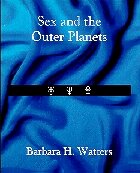
SEX & THE OUTER PLANETS - Barbara Watters, $5.95
Contents: List of illustrations; 1. The inner planets; 2. The middle planets; 3. The expanding universe;

4. Sexual distortion in the Saturn dominated chart: i. Adolf Hitler, ii. The Marquis de Sade;

5. Sexual distortion in the Jupiter dominated chart;

6. The outer planets: i. Uranus, ii. Neptune, iii. Pluto

7. Uranus as a sex significator: i. Homosexuality - rebellion, ii. Somerset Maugham & Gertrude Stein;

8. Neptune as a sex significator: i. Masochism, ii. Impotence;

9. Pluto as a sex signficator: i. Violence & delinquency, ii. Rape;

10. Pluto & genius: i. Sublimation of sex & violence, ii. Pasteur, iii. Van Gogh, iv. Eugene O'Neill

Appendices: A. Formula for casting Johndro charts; B. Source data for the horoscopes used in this book; C. Karl Marx - horoscope data.

Comment: Contrasts American & European sexuality & how Charlemagne's coronation turns up in Hitler's chart. Among other highlights: Sexual attitudes of European civilization: the predatory male, sex as sin, the female principle as evil. Sexual attitudes in the US: emerging matriarchy, guns & money as substitutes for sex. Sexual distortions of Saturn: sadism, guilt, anal eroticism. Sexual distortions of Jupiter: voyeurism, exhibitionism, promiscuity. Uranus as sexual significator: homosexuality, rebellion, fanaticism, the castration complex. Neptune as sex significator: masochism, impotence, narcissism, drugs. Pluto as sex significator: violence, rape, the criminal gang, group sex.

Valhalla, 222 pages.


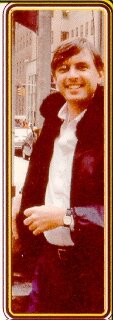
(l-r, Steven & Jeffrey)
MEASURING THE NIGHT: Evolutionary Astrology & the Keys to the Soul - Steven Forrest & Jeffrey Wolf Green, $19.95
Contents: Acknowledgments; Dedication; Foreword by Kelli Fox; Introduction by Jeffrey Wolf Green;

1. Laguna Beach workshops: Introducition; 2. Laguna Beach workshops: Green on trauma; 3. Laguna Beach workshops: Handout on trauma; 4. Laguna Beach workshops: Forrest's case study of "Persephone"; 5. Laguna Beach plenary session after Persephone;

6. Arizona workshops: Forrest: The nodes of the moon; 7. Arizona workshops: Green: The planetary nodes; 8. Arizona workshops: Forrest: The sun;

9. Saramento workshops: Green: Saturn, Capricorn & the dark Eros;

10. Laguna Beach workshops: Volunteer chart, analysis by Forrest & Green.

Epilogue by Steven Forrest; Appendix: The astrological ages & sub-ages, accoding to Marc Robertson in Time Out of Mind.

Comment: From the back cover:

Astrology, sacred psychology & reincarnation come together seamlessly in the hands of the world's premiere metaphysical astrologers. Jeffrey Green's work "mirrors the eternal realities of the soul", according to the leading Danish astrology magazine, St. Jernerne. Sting calls Steven Forrest's work, "as intelligent and cogent as it is poetic." Together they push the ancient symbols of astrology to new heights of insight, lucidity & compellingly showing us how the soul's long journey is reflected in the birthchart. Beyond the randomness of life, there is a clear & meaningful order. Measuring the Night provides the Rosetta Stone for unraveling it.

The sequel, Measuring the Night vol. 2 seems to have gone rapidly out of print.

Seven Paws Press & Daemon Press, 363 pages.


ASTROLOGY: WOMAN TO WOMAN - Gloria Star, $19.95
Contents: Introduction; 1. An overall glimpse of your astrological chart; 2. Projection of your real self; 3. Understanding your inner feminine self; 4. Owning your inner masculine self; 5. Developing your mind; 6. Your special edge; 7. Nurturing & creating a home; 8. Meeting the world on your own terms; 9. Opening your heart; 10. Power issues: sex, money & control. Bibliography, Index.

Comment: This is how to read a natal chart if you happen to be a white, middle class American female around the age of 35, circa 1995 (this book copyright 1999). And if you accept all the cultural baggage that implies, this is a useful book.

But as far as Female Horoscopy is concerned, the book is silent. That study starts with the chart for the onset of menses, the moment a child becomes a woman. If I am not mistaken, the menses chart should provide definitive answers to questions such as: If she will have children or not, and if so, how many children will she bear, which will be male, which female, which will survive, if the woman will give birth easily or not (or if she may die in childbirth), if she will enjoy procreation or not, etc. The onset of menses is the defining moment in a woman's life, when she forever becomes different from the male. In Vedic astrology, this is an entire study. For more, see Female Horoscopy (Strijataka), by B. Suryanarain Rao, as revised by his grandson, B.V. Raman.

Llewellyn, 465 pages.


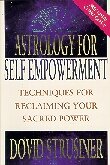
ASTROLOGY FOR SELF-EMPOWERMENT: Techniques for reclaiming your sacred power - Dovid Strusiner, $12.95
Contents: List of illustrations; Tables; Acknowledgments; Introduction; Prologue

1. The magic of astrology; 2. Celestial self-discovery; 3. Astrology for self-empowerment; 4. The signs of the zodiac; 5. The planets; 6. The ascendant & the houses; 7. Aspects of sacred change; 8. Astrological affirmations & invocations; 9. Zodiacal & planetary visualizations; 10. Aspects & crystal energy transformation; 11. Finding the major themes in your birth chart; 12. Creating your program for self-change; Epilogue; Glossary; Index.

Comment: Here's the essence of this book, a five step process:

  • Step one involves learning about the signs, planets, houses & aspects & their part in the practice of Sacred Astrology.
  • In step two you will be introduced to the specific techniques of the astrology of self-empowerment, including affirmation, visualization, and crystal energy transformation. As you study these techniques you will learn how to affect fundamental changes in your psycho-spiritual nature.
  • Step three teaches you how to find the major themes & potential in your birth chart. This knowledge not only allows you to determine which planetary & zodiacal symbols to work with to affect sacred soul alchemy, but significantly, it also facilitates learning to unleash your creative force & invoke the healing energy within.
  • Step four is the design of your personalized astrological program of self-change - a program centered upon your major themes, patterns, & inner potentiality. At this point in the process you decide which areas of your life you wish to work on. You also choose specific exercises & therapies from those provided (affirmations, invocations, visualizations, and crystal energy therapies) or you create your own personalized exercises & therapies.
  • Step five is the ongoing practice of the techniques of Sacred Astrology. (from pgs 20-21)
Some quotes:

Alchemy is nothing but the art which makes the impure into the pure through fire - Paracelsus (pg. xi).

Astrology awaits its renaissance in the hearts of each of us. (pg. xiv).

We are, potentially, both the controlling center & the dynamic point of self-awareness that determines how a crisis or an event is integrated into our consciousness. (pg. 18).

An invocation of Mars: Come to me mighty warrior. I invoke the daring courage & power of Mars to enter my life. I feel your passion & strength. I call forth the spirit hero within myself to resonate with your energy. I am now vitalized with initiative, drive & masculine force (pg. 121). (Am glad he hasn't a clue what he just tried to do.)

Whole of Zodiac Breathing Exercise (pg. 127).

Planetary Rainbow Dance Exercise (pg. 129).

Solar Uranian Visualization Exercise (pg. 132).

If this speaks to you, get this book.

Llewellyn, 168 pages.


Astrological Essays: Page 1 Page 2 Page 3


The Astrology Center of America

207 Victory Lane, Bel Air, MD 21014
Tel: 410-638-7761; Fax:410-638-5154; Toll-free (orders only): 800-475-2272

Home Author Index Title Index Subject Index Vedic Books Tarot E-Mail: Dave


Established 1993, The Astrology Center of America is owned & operated by David Roell.
This entire site (AstroAmerica.com) is copyright 1996, 1997, 1998, 1999, 2000 by William R. Roell.
All rights reserved.