The Astrology Center of America, 207 Victory Lane, Bel Air, MD 21014
Tel: 410-638-7761; Fax:410-638-5154; Toll-free (orders only): 800-475-2272
Home Author Index Title Index Subject Index Vedic Books Tarot E-Mail: Dave


Astrological Forecasting, page 6


Forecasting Pages: 1 2 3 4 5 6

Indicates a book on our Top Ten list. If you would like to find more books like it, click on the star.
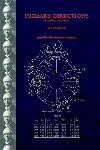
PRIMARY DIRECTIONS: A Definitive Study - Sepharial, $17.95
Contents:
1. Astronomical Definitions
2. Example Horoscope
3. Directions in Mundo
4. Directions in the Zodiac
5. Zodiacal and Mundane Parallels
6. Order of Directing
7. Effects of Directions
8. Planetary Indicators and the Measure of Time
9. Illustration
10. Ptolemy and Placidus
11. Directions Under Poles
12. The Part of Fortune
13. Lunar Parallax and Semi-Diameter
14. Lunar Equations
15. Cusp Distances
16. Suggested Method of True Directing
17. Conclusion

Appendix—Tables of Sines, Tangents, etc.
Tables of Right Ascension and Ascensional Difference
Tables of Proportional Logarithms

Comment: The definitive text on Primary Directions, written by a 20th century master.

Sepharial (1864-1929) was one of the leading astrologers in the early 20th century English astrological revival. Primaries were his favorite means of forecasting. Primaries, unlike simple transits or secondary directions, are not immediately obvious to the average student. So in this book, the author starts with the basic definitions. He then explains how to calculate directions in mundo, directions in the zodiac, as well as parallel directions. He suggests methods of organization and describes what effects primary directions may produce. In the process he gives an overview of the three main schools of forecasting: The Fatalists, the Casuists, and the Idealists, and gives the pros and cons of each.

Sepharial then discusses the two major individuals behind primaries. These are Claudius Ptolemy, who invented the semi-arc (primary) method in the second century AD, and the 17th century Italian monk, Placidus de Titis, who devised the complex house system that enabled primaries to be calculated easily and rapidly.

Sepharial next tackles directions under Poles, which were a favorite of R.C. Smith, the first of several men known as "Raphael". Then, the resolution of problems unique to Primaries: The proper method to calculate the Part of Fortune (Oblique Ascension/ Descension, rather than simple zodiacal longitudes), various unique challenges with primary directions and the moon, and the true way to calculate directions to house cusps, along with some novel shortcuts.

Expanded and revised, this book, originally entitled Directional Astrology, was the successor to the author's earlier Prognostic Astrology. It is also superior to the better known Primary Directions Made Easy.

Using this system, Sepharial made many notable forecasts, most famously that of the end of World War I and the abdication of the Kaiser. Interest in this fascinating system has increased since the mid-1990's. This is the finest book ever published on the subject, one that will repay study.

Click here for an excerpt (pdf).

Astrology Classics, 168 pages.


PRIMARY DIRECTIONS OF REGIOMONTANUS & WILLIAM LILLY - Rumen Kolev, $15.00
Contents: History of Regio directions; The basis of the primary directions; The Regiomontanian interplanetary directions; The Regio math algorithm; Zenith distance & pole computation; Practical computation of a Regio direction; How did Regiomontanus direct? Details; Mundo Regiomontanian primaries; Bibliography; The primary directions of William Lilly; Bibliography; Computer programs for primary directions & 3D.

Comment: What kind of primaries you get depends on the house system you use. Kolev has traditionally used Placidus cusps, as Placidus de Tito, the guy who devised the house system with his name on them, invented them specifically for the sake of primary directions. William Lilly calculated primaries with Regiomontanus houses. How successful was he? Kolev explains the differences in great detail. Among his conclusions: Lilly used the Ptolemy key for initial orientation & the Naibod key for more exact results. Lilly directed only in direct motion. He also used solar returns & profections, which could influence weak primaries. A strong primary for Lilly could indicate an event as well as a period. Kolev sums up & says the accuracy of Regiomontanian & Placidian zodiacal directions are low. Pending further research, Kolev prefers Placidian mundo directions & suggests not to use Regiomontanus cusps with Primary directions. Which suggests that each house system has its intended uses & that astrology improves when we select the best house system for the job at hand.

I once thought that Lilly knew of Placidian cusps. After careful study, and with the advice of Geoffrey Cornelius, I have concluded that I was wrong. William Lilly most likely never heard of them. Please accept my apologies for the mistake.

Astro-Research Center, 60 pages.


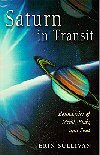
SATURN IN TRANSIT, Boundaries of Mind & Soul - Erin Sullivan, $19.95
Contents: Acknowledgments; Introduction; 1. The evolution of an archetype: Kronos the Titan, The mythic Kronos & the Roman Saturn, The old malefic, The midwife of insight, The alchemical lead, The master of time;

2. The natural cycles of Saturn: A journey towards individuation, Birth to Saturn square (0-7), Square to opposition (7-14), Opposition to square (14-21), Square to return (21-29), Return to square (29-36), Square to second opposition (37-44), Second opposition to square (45-52), Square to second return (52-59), Second return onwards;

3. The heroic round: Heroism, Hamartia: the hero & the tragic flaw, The mythological round, The angles;

4. The personal heroic journey: Experiencing boundaries, definition & containment; Seeing the inside on the outside; The transit of Saturn over the angles; The call to adventure (MC); The threshold struggle (ASC); The atonement (IC); The call to return (DESC);

5. The transit of Saturn to the planets: Aspects: The eye of Saturn, The story of Job, Saturn in transit to natal planets.

Notes; Bibliography; Index; About the author.

Comment: Saturn's influence, its quest for meaning as it transits around the zodiac, helps us to destroy the old & outmoded. By throwing us into periodic chaos, Saturn encourages redefinition & regrowth & so becomes an agent of change (for the better) in our lives. Make Saturn your friend, you'll never regret it.

Weiser, 337 pages.


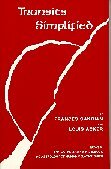
TRANSITS SIMPLIFIED - Sakoian & Acker, $14.00
Contents: Introduction; How to use this book; The transits:

  • Keywords for the transiting Sun
  • Keywords for the transiting Moon
  • Keywords for transiting Mercury
  • Keywords for transiting Venus
  • Keywords for transiting Mars
  • Keywords for transiting Jupiter
  • Keywords for transiting Saturn
  • Keywords for transiting Uranus
  • Keywords for transiting Neptune
  • Keywords for transiting Pluto

Comment: Delineates transiting planets (Sun, Moon & planets) to other planets, through the houses, in aspect to the angles & nodes. Aspects: Conjunctions, sextiles, squares, trines & oppositions. Gives interpretation for faster transiting planets to slower natal planets. For the reverse, when slow planets make transits to faster planets, the text refers the reader to the earlier sections. So, for example, the text delineates transiting Sun to natal Pluto, but for aspects of transiting Pluto to the natal Sun, the text refers the reader to the Sun to Pluto section. This is not exactly kosher, but if you're clever, it will do. Some years after this book was first published, the authors took these keywords & wrote them into a proper book, Predictive Astrology, which was published by Harper. It's been out of print since 1998. If you're looking for a copy, you might try the used vendors at Amazon. It's a book some enterprising person should reprint.

NESA, 227 pages.


WHAT'S A DIURNAL - Maxine Taylor, $10.00
Contents: 1. What's a diurnal?; 2. How do you cast a diurnal chart?; 3. Example charts - marriages, births, deaths, divorces/separations, new business ventures, miscellaneous, A congressional race; Patricia Hearst; 4. When the diurnal doesn't work; About the author.

Comment: From chapter 1:

To calculate a diurnal, the birth chart is first relocated to the place of the event or activity. Then, using the relocated calculations, another chart is cast for the day in question. This is the diurnal. Once the cusps for this chart have been found, there is no further calculation. Allowing a one degree orb, we simply see if any of the natal, progressed or transiting planets as well as natal or progressed cusps are conjunct any of the diurnal cusps. (Converse motion, solar arc, progressed relocation and natal relocation planets and cusps can also be included.)... Events occur in the life when a natal planet is conjunct a diurnal cusp, or when more than one progressed or transiting planet is conjunct a diurnal cusp. The more planets conjunct any one cusp, the more important the event. (pg. 1)

To clarify the calculation instructions, the "relocated calculations" refer to the relocated house cusps, which are generated from the relocated Sidereal time of birth. The rest of the instructions are murky. To clarify, they are: To cast a diurnal for today for your place of birth, take your natal time of birth (with your natal time zone), your natal birth place, and add today's date. To cast a diurnal for today for a relocated place of residence, take your natal time of birth (with your natal time zone), your present location, and today's date.

So if you were born in New York on January 15, 1973 at 3:32 am EST, your New York diurnal for October 4, 2005, would be calculated for 3:32 am EST, New York, October 4, 2005. To calculate for October 5, 2005 (the next day), change only the date.

If you were born in New York but now live in Los Angeles, a diurnal for October 4, 2005 would be calculated with your original birth time, (3:32 am EST), the latitude/longitude for Los Angeles, and the date of October 4, 2005. In both cases, it is helpful to place natal planets & angles outside the diurnal chart. Once you get into diurnals, you'll do this every day, especially if you have a computer program.

The day's diurnal becomes of interest when natal planets & angles are in conjunction with diurnal angles. They become even more interesting when joined with transiting planets on diurnal angles.

AFA, 51 pages, small paper.


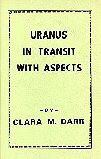
URANUS IN TRANSIT WITH ASPECTS - Clara M. Darr, $10.00
Contents: Uranus transits houses; Uranus aspects Sun; Uranus aspects Moon; Uranus aspects Mercury; Uranus aspects Venus; Uranus aspects Mars; Uranus aspects Jupiter; Uranus aspects Saturn; Uranus aspects Uranus; Uranus aspects Neptune; Uranus aspects Pluto.

Comment: For each of the natal planets, Darr gives delineations for the conjunction, sextile, square, trine & opposition. Features a psychological approach, with much left between the lines. Here is Uranus conjunct Venus:

You will probably experience some unexpected alterations in the pattern of the lighter side of your life. Get your attitude toward others very clear because upsetting unconventional influences are at hand.

You are apt to spend a little extra on amusement or adornment in this cycle. Look your best, add to your sense of comfort and well-being. Pleasurable and/or emotional affairs should be improving. You can purchase articles of dress & personal interest to advantage.

You probably will find an increase in craving for thrills. It is up to you to keep this desire from getting out of hand. Be sure you comprehend just where each individual stands & what his or her rights are before you express an opinion involving important considerations. Be logical & impersonal. Stick to customary behavior. (pg. 21)

Self-published, 48 pages, small paper.


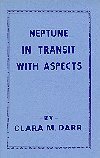
NEPTUNE IN TRANSIT WITH ASPECTS - Clara M. Darr, $5.00
Contents: Neptune transits houses; Neptune aspects Sun; Neptune aspects Moon; Neptune aspects Mercury; Neptune aspects Venus; Neptune aspects Mars; Neptune aspects Jupiter; Neptune aspects Saturn; Neptune aspects Uranus; Neptune aspects Neptune; Neptune aspects Pluto.

Comment: The emphasis is on practicality. Here is Neptune opposing natal Mars:

Be prepared for the unexpected in a business offer which seems too good to be true. It might be advantageous to turn it down because instead of becoming a huge success, the plan may fall apart at the last moment.

Tendency to bring out your worst enthusiasm. Sensational and Ultra-romantic ideas can dominate you. This goes on for a long time and you may get used to it as time goes on. Be careful that you aren't taking your weaknesses too much for granted. Examine yourself, your pursuits, your pleasures, your associates; and you will find that a lot of them are profitless and wasteful, if not worse. Look within yourself, and discover the root of the evil, then cast it out of your life, through a careful campaign to redirect your energies into more progressive channels. (pg. 27)

Self-published, small paper, 43 pages.


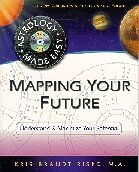
MAPPING YOUR FUTURE - Kris Brandt Riske, $19.95
Contents: List of charts; Acknowledgements; Introduction; 1. Natal chart overview; 2. Predictive techniques; 3. Natal chart delineation; 4. Progressions; 5. Progressed planets in houses, signs & aspects; 6. Outer planets & eclipses; 7. Outer planet transits, houses & aspects; 8. Inner planet transits; 9. Inner planet transit, houses & aspects; 10. Relationships; 11. Job/career; 12. Money; 13. Relocation; 14. Health.

Glossary; Appendices: 1. Step-by-step guide to making predictions; 2. Map your future using the CD-Rom; Bibliography.

Comment: Riske is the author of a fine book on weather forecasting, she is also in charge of publishing at the AFA, so there's no question she knows her stuff.

This is a quick overview of astrological forecasting, lacking many useful details. We are told what progressions are, we are told what transits are, we are given tiny snapshot delineations of transiting & progressed planets, we are given one fully worked-out example (of David, born in 1966) and his sudden breakthrough job of 1991. In the chapters dealing with specific topics (Relationships, Job, Money, etc.) there is a smorgasboard of configurations, preceeded with,

Listed here are the aspect configurations present at the time of marriage or commitment. Each component must be "active"; that is, each appropriate planet & angle must be aspected by an outer planet transit or progression. Usually there are multiple aspects, but it's only necessary for there to be one to each. For example, there could be an aspect to the progressed Ascendant/Descendant, but not to the natal angle. The same applies to the planets. (from pg. 142)

In this instance, there follows 33 itemized configurations: Eclipses, natal planets, natal angles, progressed planets, progressed angles, progressed ruling planets, progressed planets in houses, outer planet transits to houses, natal planets, progressed planets, new & full moons, stationaries/retrogrades. Which would seem to be a puzzle. Does nothing happen unless it's indicated a dozen times over? Of course not. What the author is trying to give us is the entire range of possibilities, from which only a few need be operational. The confusion seems to stem from the editing of the book and not the author's text itself. So, in general, are Llewellyn's editors to blame for the flabbiness of the Mapping series? (What do they know of astrology, I wonder?)

The CD-Roms with the books are taken from programs by David Cochrane (Cosmic Patterns Software). They will calculate & display a chart & as an added bonus, also include the author's interpretation, keyed to the book. In this case, forecasts. This just might be what you're buying for your twenty bucks.

Llewellyn, 216 pages.


Forecasting Pages: 1 2 3 4 5 6


The Astrology Center of America

207 Victory Lane, Bel Air, MD 21014
Tel: 410-638-7761; Fax:410-638-5154; Toll-free (orders only): 800-475-2272

Home Author Index Title Index Subject Index Vedic Books Tarot E-Mail: Dave


Established 1993, The Astrology Center of America is owned & operated by David Roell.
This entire site (AstroAmerica.com) is copyright 1996, 1997, 1998, 1999, 2000 by William R. Roell.
All rights reserved.