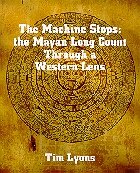
The author has been so poorly served by his publisher that I think he should ask them to re-do his book. There is no table of contents, there is no index, there are no headers at the top of the page to tell us what chapter we are in, there are virtually no sub-heads to break up the flow of text. Consequently we open the book at random, we have no idea what we are reading. So we are forced back to the very beginning, and must discover the book one page at a time. So let's do that.
The author makes a bad start in the Introduction by telling unrelated stories. A lot of authors waste ink like this, but in other books we can skip ahead and know what we are skipping into: First chapter, second, third, etc. In this book, we can't, because we don't even know if there are chapters, much less where they are. All we see is a running text. Page v, General Motors. Page vii, Neolithic shrine. Page ix, time that has meaning. Page xi, destruction as metaphors for the collective demand for transformation. - At which point we surmise the author has no point of view and is rambling.
We turn pages, searching for Chapter 1. Before we find it, we find several pages of chartwheels. The first for December 21, 2012, Palenque, Mexico, which is the end of the Mayan calendar, more or less. Next,a bi-wheel for 3114 BC and 551 BC. Then a chart for 3114 BC (the start of the current Mayan calendar, by the way). Then a tri-wheel: 3114 BC, the same chart progressed to 1890, then a transit chart for 1890, these two dates referring to the Wounded Knee massacre. Next, another tri-wheel, 3114 BC, progressed to 551 BC, and then transit to 551 BC. Followed by a tri-wheel, 3114 BC, progressed to 2012, and then transits to 2012. And then the final chart, another tri-wheel: 3114 BC, progressed to 1398, transits to 1398. If we read the text very, very, very closely, we might discover why these charts are important. But in the meanwhile, we have discovered Chapter 1.
Chapter 1 introduces the traditional astrological ages. So we are to compare the Mayan long count to astrological ages, more or less. The long count is 5125 years (remember: No year zero!), an astrological age is around 2200 years, so there's about two and a third astro ages in one long count. Lyons has a concept for the Ages, which is unusual, as most people simply ape the Piscean age we've just left. After a lengthy survey of astrological ages, Lyons gets down to business comparing the long count to the Age of Taurus. Which becomes an excuse for commentary on current events, c.2009, when the author was writing this book. 3114 BC gets mentioned as being Sumerian, which seems to have put an end to previous barbarities before introducing newly civilized ones (pg. 31).
Chapter 2, Mayan and Western Astrologies, starts with a discussion of the Mayan calendar. This takes us to a discussion of the Septile, which, at 51 and a fraction degrees, relates to a 52 year Mayan time span. This leads to several pages of discussion about septiles and astrology. We then get much the same for the Quintile, of 72 degrees, which relates to the Mayan 72 year cycle. Page 49, we learn that septiles have to do with the individual and the collective, while the quintile is concerned with the inner self. Septile = outer, quintile = inner. At this point I was hoping Lyons would reveal a 52 or 72 year pattern to events, but instead the book rushes on to karma, cosmic law, and artifice. Which is followed by the Venus cycle, which produces 104 years (52 doubled). Other sections follow. Lyons brings up the 60 year Chinese cycle, which he says is based on no astronomical cycles at all. In fact, Chinese astrology is based on five cycles of Jupiter and two of Saturn, as any good Chinese scholar will tell you. Lyons is merely showing the thinness of his studies.
Chapter 3 is the Long count natal horoscope. This is a delineation of a chart set for August 11, 3114 BC, at midnight in Palenque. Lyons proceeds to interpret this as a straightforward natal chart, but without the angles, as he is unable to fix a time. Here is part of the Summary:
The Long Count horoscope, with its powerful square involving Mars and Neptune, certainly suggests delusion-driven military aggression of an extreme sort, all in the service to the king (Leo). The horoscope also suggests, through the yod to Mercury-Venus and the various Leo-Capricorn quincunxes, a quasi-ritualistic union of kingship with bureaucracy, all resulting in excess (Jupiter). The powerful quincunx from Saturn to Uranus and Pluto, running parallel to the one from Mercury-Venus to the Moon, suggest the cooption of invention by the forces of the status quo - by, we might say, the king's bureaucracy (Saturn in Leo dispositing Uranus). This description takes into consideration all the planets in the horoscope. (pg. 110)
This applies to who or what, precisely?
Chapter 4 is Time Analysis, which is the long count chart (above) progressed and with outer planet transits. In this chapter we find references to 551 BC, as well as 1398 AD. Which are used as straw men. Wounded Knee turns out to have taken place at the time of the Neptune-Pluto conjunction in Gemini. Which for some reason is important to the long count, on the one hand, and is the most significant event to have occurred during the very long-running Neptune-Pluto conjunction of that era. The chapter ends with a forecast for, well, December 21, 2012, which is expected to bring war:
So an honest appraisal of the evidence tells us that the dire warnings of disaster at Long Count's end don't seem at all far-fetched. They seem, rather, aptly symbolized by the astrological configurations. (pg. 160)
The reader can see, then, that the transiting and progressed factors for December 21, 2012 do seem rather extraordinary, bringing together all of the major configurations of the natal horoscope. (pg. 161: My emphasis)
The Long Count's conclusion seems to mark a point of no return. (pg. 162)
Decision makers both with and without power will find their hands forced . . . with the danger of destructive war looming in the background. . . (pg. 162)
We shouldn't necessarily expect catastrophe on December 21, 2012. (pg. 163)
The author seems blind to the horrific wars of the 20th century, not to mention the continued state of warfare that began in 2001. In books like this, what's coming is always worse that what has already happened, or you - and the author - won't be properly frightened.
The final chapter, Chapter 5, The Next Long Count starts off by wondering if there will be another long count. Which I presume means the Mayans and their counts will disappear, or the sky will fall. Lyons struggles with interpretation going forward. I don't think his heart was in it.
Or, well, maybe the publisher did such a poor job because they simply did not read the book.
AFA, 210 pages.