The Astrology Center of America, 207 Victory Lane, Bel Air, MD 21014
Tel: 410-638-7761; Fax:410-638-5154; Toll-free (orders only): 800-475-2272
Vedic TITLE Index Vedic AUTHOR Index Vedic PAGES Index Vedic SEARCH Engine Astrology Home E-Mail: Dave


Vedic Astrology:

Books by J.H. Bhasin


In the front of Hora Shatak is this:

A Tribute
The late Shri J.N. Bhasin was one of the greatest exponents of Hindu Astrology. His deep study, keen intellect, unquenchable thirst for knowledge, original thinking and practical experience, turned him into an astrologer and writer of great eminence. He wrote both in Hindi and English. All his books are simple in langauge, easy to follow, and are extremely rich and instructive in content. They are of a high standard and are authoritative. They contain many rules and principles which have been brought to light for the first time. There will hardly be any student of Hindu Astrology who will not have Shri Bhasin's books in his Library. ...

The great savant is no more but the rich treasure of knowledge left by him will continue to guide the aspiring students of astrology, like a luminious lighthouse.

Regret I could not find a photo of Shri Bhasin. Here are his books:

Vyankatesh Sharma's SARVATH CHINTAMANI - translated by J.N. Bhasin, $18.00
Contents:
Introductory note; 1. Rashi vichar (definitions & elementary principles); 2. Lagna phal vichar; 3. Results of 2nd house; 4. Results of 3rd & 4th houses; 5. Considerations of 5th & 6th houses; 6. Considerations of 7th house; 7. Considerations of 8th & 9th houses; 8. Results of 10th, 11th & 12th houses; 9. Raj yogas; 10. Span of life;

11. Cancellations of yogas for short life; 12. Medium longevity; 13. Ruling periods of sun & moon; 14. Ruling periods of Mars & Mercury; 15. Ruling periods of Jupiter, Venus & Saturn; 16. Ruing periods of Rahu, Ketu & sub periods; 17. Miscellaneous.

Comment: The translator says this: From the point of view of practical utility [this book] offers very valuable comments on the subjects relating to each of the 12 houses of a birth chart. It has the unique distinction of following a procedure whereby the main subject or objects pertaining to a house are first of all stated in the very beginning of the chapter relating to that house and then each of those subjects is dealt with in a suitable astrological way.... For example in the first shloka of chapter 3 dealing with the affairs of the 2nd house of the horoscope, the author - Shri Venktash Sharma has given family, dependents, mouth, speech, right eye, accumulated wealth, education, eating, servants & friend as affairs covered by the 2nd house. He then deals with each of these affairs in detail. For example: He states that if a natural benefic planet occupies the 2nd house, and the lord of the 2nd is also a natural benefic planet and the significator - the sun - is under good influence the man has broad eyes with good sight. Similar treatment is accorded to other affairs. (page 1)

With Sanskrit slokas.

Sagar, 371 pages, paper.


ASTRO SUTRAS - J.N. Bhasin, $9.00
Contents:
A word or two;
1. An introduction to the subject matter; 2. An introduction of planets; 3. Some fundamental & important rules explained; 4. The first house or the ascendant (lagna); 5. The second house; 6. The third house; 7. The fourth house; 8. The fifth house; 9. The sixth house; 10. The seventh house; 11. The eighth house; 12. The ninth house; 13. The tenth house; 14. The eleventh house; 15. The twelfth house; 16. Example horoscopes for critical study; Index.

Comment: A basic text on natal charts. Inspired by Deva Keralam, Sarvath Chintamani, Uttar Kalamrita & Saravali, which are quoted in the book. For each house, the various signs & planets domiciled in them are considered. Many specific aphorisms & yoga combinations, though not labeled as yogas.

Sagar, 266 pages.


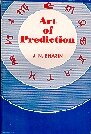
ART OF PREDICTION - J.H. Bhasin, $9.00
Contents:

Introduction
1. Rules traced & explained
2. Pillars of the astrological edifice
3. Principles of Parashar
4. Departments of life
5. Dasa
6. Timing of events
7. Erection of a birth chart
Bibliography

Comment: A general introduction to astrological interpretation, based on Parasara, Brihat Jatak, Phal Deepika, Uttar Kalamrit, Sarvath Chintamani, Prashna Marga, Bhavartha Ranakar, Saravali, Jatak Parijat, Chandra Kala Nadi, etc.

In the first chapter, the rules are interesting. All retrogrades are strong. Jupiter is important in a woman's chart as it indicates the husband, Saturn represents animals, Mars & moon represent blood, Moon should be treated as lagna, Plurality (twins), Medical line (sun), Music & musical instruments (Venus), Quickness of results (Mercury), Cause of divorce, Strong & weak planets, Factors enhancing value, Criteria for benefics & malefics, Aspects, Malefic planets in trines, Mental deficiency, Planets in lagna & disease, Aristocratic factors, Longevity, Traits of first house, Planets aspecting own signs, Lagna & life, Adultery & the 4th house, Things made alien by the 6th house, Past present & future, Foreign travel, Scantiness & death a trait of the 6th house, Marriage relates to 2nd house as well, Cinema - representationn of, Loss of wealth by government order, etc. This is only the first chapter. The others are organized in similar fashion.

There seems to be a lot of interesting things here, in no particular order. On page 190, he remarks that the 5th house predicts the future, while the 9th house knows the past. In examining the chart of a woman who knew her past life, Bhasin says if the lord of the 9th is intimately linked to knowledge, one knows his past life. Notice he did not say, "remember". There are many ways to know.

Sagar, 300 pages.


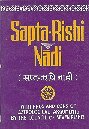
SAPTA RISHI NADI - J.N. Bhasin, $7.00
Contents:
Introduction;
1. General review of the nadi; 2. Rules for interpretation; 3. Arguments for & against; 4. Birth to brothers (1 to 3 houses); 5. Comforts to enmity (4th to 6th houses); 6. Wife to luck (7th to 9th houses); 7. Fame to moksha (10th to 12th houses); 8. Dasa & nadi; 8. Multiple marriages.

Comment: On the cover it says, With pros & cons of astrological arguments by the council of seven rishis. As given in the first chapter, the seven are: Atri, Agastya, Jaimini, Songinar, Narad, Vashisht & Vishwamitra. Originally in Tamil, this (condensed?) edition does not have original Tamil slokas, but does quote Sanskrit slokas from other references on occasion. This book covers charts with Aries through Leo lagnas, the remaining signs were to be taken up elsewhere at a later date. This is a compilation of charts with brief, traditional analysis. On pgs 12 - 13 is a long list of all the characteristics each analysis is to provide (type of house of birth, description of grandfather, father, marriage, children, spouse, illness, death, etc.), though, in the actual text, one tends to cut directly to the chase, eg, the crux of the chart itself. Often, a chart analysis covers a single topic, as for example:

Conceit (I): The father of the native to whom Birth Chart 19 of Leo ascendant belongs is stated by the Nadi to be conceited. What is conceit? It has been defined by dictionaries as "personal vanity" which obviously means giving too much thought & importance to self. Now the factors for 'self' are 1st house, 3rd house, 10th house, 11th house & Sun. If therefore, the first house or its lord is very much associated to one or more of these houses we may reasonably conclude the person is conceited, more particularly in cases where the constituent factors of the Yoga & Mars & Saturn - the tasmic planets. Let us now study the birth chart in light of the above remarks. Mars, lord of the 9th house representing the self of the father of the native is in the company of Saturn, lord of the 10th house from the father thereby constituting a Yoga of conceit for the father. Considering the problem from the Chandra Lagna, we find that Saturn & lord of the 9th house therefrom is in company of Mars, lord of the 10th house from the father's thereby constituting a Yoga of conceit for the father. (pgs 59-60)

Ranjan, 208 pages.


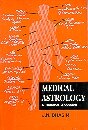
MEDICAL ASTROLOGY, A Rational Approach - J.N. Bhasin, $9.00
Contents: A word or two; 1. Some fundamental principles; 2. Some important rules of astrology; 3. Kala Purusha & disease; 4. Lagna & disease; 5. Isolated planets & disease; 6. Determination of disease by its definition; 7. Cause of death & disease; 8. The system of Sudarshan & disease; 9. The sixth house & disease; 10. Balarisht or disease in early childhood; 11. Sandhi (conjunction) and disease; 12. Disease - when?; 13. Astrological cure for disease; 14. Diseases curable & incurable; 15. How to prepare a horoscope; Index.

Comment: In A Word or Two is this:

It has been endeavoured to introduce a few specialites in this book. Firstly to discuss for the benefit of the student of astrology a maximum number of diseases [this book was first published in 1986] under astrological laws. Secondly to supply in support of that discussion as many illustrations from actual life as is possible, with a view to make the subject readily understandable. Thirdly we have tried to place the astrolgical material in a rational & logical manner, so that the question of health & disease can be tackled in an independent way without being too much subservient to the shlokas of the text. We do meet with the shlokas dealing with most of the diseases but there are very few books, if at all, which discuss the "how" and "why" of disease. We have attempted to discuss the constituents of diseases & the astrological factors representing them severely in order that the student can extend the application of the method to new diseases. (pg. 1)

Sagar, 188 pages.


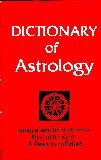
DICTIONARY OF ASTROLOGY - J.N. Bhasin, $16.00
Contents:
Section I: Terminology.
Section II: 1. Abbreviations; 2. Classifications; 3. Explanatory notes; 4. Synonyms.
Section III: Planetary combinations.
Section IV: Some useful tables.

Comment: Looks harder to use than it is, because it has a dual function: Explain all those strange words to Westerners & give Sanskrit translations for native Hindu readers of western texts. The 1st section is alphabetical, from pgs 11 to 110 (inclusive): Vedic terms (in English characters) are given English translations, and Vedic terms (in English characters) are shown in Sanskrit characters. Most, but not all, also have English translations.

The second section starts with a page of abbreviations, most of no great importance. Then we have age of planets, anatomy of the human body (English to Sanskrit), formulas for Arabic parts, Western aspects defined, a list of classic Vedic astrologers & their works, various branches of astrology (more than in western texts). There follows another alphabetical dictionary of terms, these with longer definitions (some definitions in Sanskrit only). Due to typeface & layout, this section of 51 pages is confusing.

The third section has planetary yogas & rules for matching charts (boy-girl).

The fourth section is tables. The first gives hours to GMT for various major countries, some of which are wrong. Then, a table to find sidereal time for 83.30 degrees east (the meridian for Indian Standard Time, IST), Ayanamsa correction, 1950-2051, Table of subs according to Krishnamurti Padhdhati, Dasa & bhukti periods, approximate retrograde periods of planets.

This is not the easiest book to use, but there is a lot here.

Ranjan, 243 pages, sometimes hardcover.


HORA SHATAK, Basic concepts of predictive astrology - J.N. Bhasin, translated by G.S. Kapoor, $10.00

Contents:

A tribute
Introduction

Elementary knowledge of astrology

1. Prayer
2. Special rules
3. Special concepts in respect of planets
4. Special effects of bhavas
5. Variety of yogas
6. Some examples of results of directional influences (dashas & antardashas)

Comment: Originally written in Hindi, this translation (a very good one) is by G.S. Kapoor. It is simple, direct & to the point. Here is an example:

The method for determining the time of events like marriage, dawn of fortune (Bhagyodaya) by calculating the average period of the planets like Mercury, etc. described by us in this book, has been devised after prologed research by us and will not be found in any other work of astrology. This method could also be usefully applied for determination of the duration of academic career, etc. We have only indicated the results of our research, their applicability on other matters concerning a nativity will depend on further research by the students of astrology.

The authors of various astrological works have generally laid stress on the examination of the 8th house for determining the cause of death but we feel that it is absolutely necessary to also take in to account the disposition and strength of the Ascendant and its lord for this purpose. (See sloka 64 and the illustration given by us.) (pg. 11)

Here is another example:
If Aquarius be the Ascendant or Lagna with Jupiter in the 12th conjoined with or aspected by Rahu, the native will be devoid of wealth and moral character. The reason for this is that Jupiter is a natural significator of wealth and becomes more so for the Aquarius Ascendant on account of being the lord of the 2nd and 11th houses. When such a Jupiter is in the 12th in his own sign of debilitation [Capricorn], there is no doubt the native will be deprived of wealth. But Jupiter signifies spirituality, religion and morals also. Therefore, a debilitated Jupiter with the depraved planet Rahu in the house of loss, expenditure and excesses, will make the native depraved and perverted. Such a person will have no hesitation in committing the most sinful and immoral deeds. (pg. 88)
I wish more Vedic books were written like this. There are Hindi or Sanskrit slokas in this book, but I do not know where they are from. They are possibly Bhasin's original book, which means that not only the translation but the comments as well, are by the translator, G.S. Kapoor.

On page 8, there is this:

At a glance: Judgement of horoscopes with a difference. New concepts of predictive astrology not found in other astrological works. Yogas for asceticism and separation. Aspect of a malefic even on his own house takes the life of the person connected with it. Special rules about Retrograde planets. Parshwagamini aspect and its special effects. Mercury gives quick results. Abundant wealth from Venus in the 12th & 6th houses. Diseases and their causes. Relevance of Lagna in ascertaining cause of death. Yogas for dumbness, Insanity, Leprosy, imprisonment, Vipreet Rajayoga making a person a multi-millionaire, Yoga for violent disposition. New principles about results of planets in their major and sub-periods. Novel and simple method for calculating the age for marriage & dawn of fortune. All rules and principles explained by illustrative horoscopes of known persons.

Ranjan, 172 pages. Printed: 1987.


ASTROLOGY IN VEDAS - J.N. Bhasin, $16.00

Contents:

Introduction

1. Planetary concordance
2. The astrological poetry of God
3. Vedas & the zodiac
4. Vedic names of planets
5. Relation of "symbology" to astrology
6. A prayer with clear astrological import
7. Sun: Its astrological import
8. Spiritual self & astrology
9. Role of Sun vis a vis science & astrology
10. Vedic traits of Moon
11. Vedic Moon & disease of "consumption"
12. Vedic Moon as significator of "longevity"
13. Moon's relation to the "nakshatras"
14. Vedic functions of Mars
15. Vedic Mercury: the Vishnu
16. Vedic mantra for Jupiter
17.Venus & the priciple of correspondence
18. Vedic mantra for propitiation of Saturn
19. A prayer to Rahu
20. Ketu as liberator in the Vedas
21. Astrological import of asterisms
22. Vedas & the conception of "houses"
23. Identity of the Vedic & the astrological ideal
24. Brahma, Vishnu & Mahesh in astrology

Index

Comment: On page 3 is this note:

Publisher's Note
(1) Ther is a misconception in some quarters that the holy Vedas recognize only astronomy and not astrology. This misconception has been very ably removed by the author by references to the chapters and verses from the Vedas.

(2) For the first time in the history of the astrological literature it has been shown on the basis of the recognized principles of spirituality why a particular planet is exalted in a particular nakshatra of a specific sign of the zodiac.

(3) Maharishi Parashar - the father of Indian astrology has laid down that the 7th house of the horoscope being the 12th from the 8th denotes the negation of the traits of the 8th house. Based on this principle the 12th house becomes the house of the denial of the traits of 1st house i.e. the body - physical, emotional and intellectual. The author has shown by references to the Upanishads that this principle of Maharishi Parashar is spiritually oriented, for moksha in religion too is the denial of all body consciousness.

(4) The able author has shown the astrological significance of the names of various planets etc. and thereby established an intimate relation between the Vedas and the astrological science. A study of the book will surely add to not only your astrological but also to your spiritual knowledge.

Ranjan, 133 pages. Printed: 1984.


The Astrology Center of America

207 Victory Lane, Bel Air, MD 21014
Tel: 410-638-7761; Fax:410-638-5154; Toll-free (orders only): 800-475-2272

Vedic TITLE Index Vedic AUTHOR Index Vedic PAGES Index Vedic SEARCH Engine Astrology Home E-Mail: Dave

Established 1993, The Astrology Center of America is owned & operated by David Roell. Except where noted, this entire site (AstroAmerica.com) & its contents are Copyright © 1996, 1997, 1998, 1999, 2000 by William R. Roell. All rights reserved.